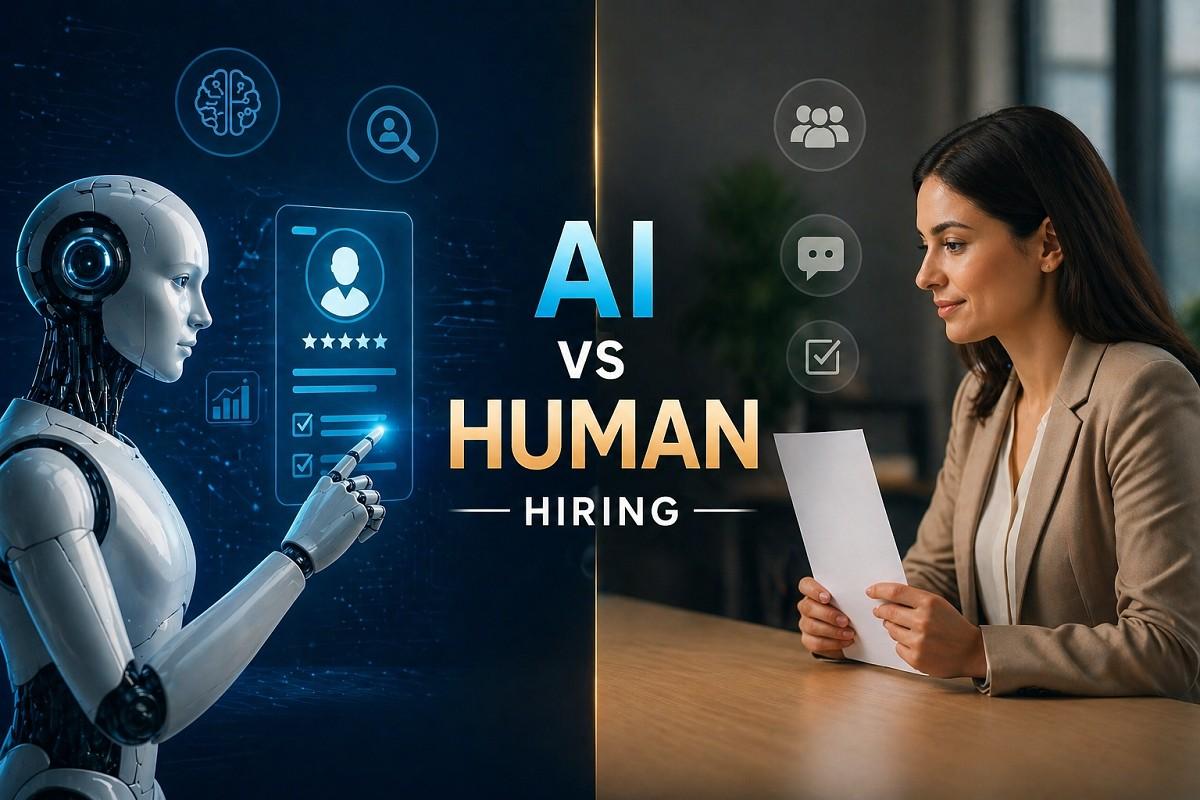
Hiring has changed fast over the last few years. In 2026, recruiters are under pressure to move faster, reduce costs, and still hire the right people. That is why the AI vs Human Hiring debate is now a real business issue, not just a trend. Employers want speed, but they also want judgment, trust, and better long-term hires.
AI now helps with resume screening, job matching, and hiring analytics. At the same time, human recruiters still lead in interviews, relationship-building, and culture fit.
For employers trying to modernize hiring, it helps to understand where AI works best and where people still matter most.
In this blog, we compare AI vs human hiring, explain their pros and cons of each, and show what works best for speed and best staffing outcomes in 2026 and beyond.
The Rise of AI in Recruitment
AI has become a core part of modern recruitment because it can handle large volumes of repetitive work at speed. Across the labour market, employers are using software and algorithmic systems to support decisions that were once handled only by hiring teams.
In addition, OECD research notes that algorithmic management and AI-based workplace tools have expanded quickly because of promised productivity and efficiency gains.
Research from IBM highlights how AI is transforming recruitment by streamlining key stages of the hiring process. From sourcing candidates to screening resumes and ranking applicants, automation is now being used across the entire hiring funnel, helping recruiters save time and make more data-driven decisions.
What AI Recruitment Tools Can Do
AI recruitment tools are commonly used for:
- Resume screening.
- Candidate matching.
- Predictive analytics for hiring success.
- Automated outreach and scheduling.
- Ranking applicants based on job-fit signals.
These systems can scan resumes, identify keywords, compare profiles to job requirements, and flag candidates who appear to match role criteria. In many cases, they also help recruiters prioritize applications faster than manual review alone.
How AI in Recruitment Can Help
When used well, AI can improve hiring in three major ways.
Faster Candidate Sourcing
AI can search large databases and surface possible matches quickly. This is useful when employers need to fill multiple openings or deal with urgent staffing needs.
Reduced Administrative Workload
Recruiters spend less time on repetitive tasks like shortlisting, scheduling, and sorting resumes. That gives them more time for interviews and candidate communication.
Data-Driven Hiring Decisions
AI tools can identify patterns in applications and historical hiring data. This can help teams make more consistent decisions, especially in high-volume recruitment.
The Value of Human Recruiters
Even with better automation, hiring is still about people. A resume may show skills, but it does not always reveal motivation, attitude, reliability, or communication style. That is where human recruiters remain essential.
Emotional Intelligence in Hiring
Recruiters bring empathy and judgment to the hiring process. They can:
- Understand culture fit and soft skills.
- Ask follow-up questions in interviews.
- Notice hesitation, confidence, or motivation.
- Build trust with candidates.
This matters even more in a competitive labour market where candidate experience affects acceptance rates and retention.
Handling Complex or Specialized Roles
Some roles are simply harder to fill with automation alone. Skilled trades, apprenticeships, warehouse leadership, site supervisors, and labour-intensive jobs often require practical judgment. Recruiters can look beyond keywords and assess real-world readiness, safety mindset, availability, and work ethic.
They also play a major role in negotiating terms, explaining job expectations, and onboarding candidates personally. For labour-focused hiring, that human contact can make a big difference in reducing drop-off and improving retention.
AI vs Human Hiring: Pros and Cons
The AI vs Human Hiring debate is not really about picking one side forever. It is about understanding trade-offs.
Pros of AI Hiring
- Speed and scalability.
- Faster resume screening.
- Easier handling of high application volume.
- Better process consistency.
- Potential to reduce some forms of unconscious bias in early screening.
Cons of AI Hiring
- Limited human judgment.
- Risk of missing non-traditional but strong candidates.
- Potential bias in AI algorithms if training data is flawed.
- Less personal candidate experience.
Pros of Human Hiring
- Personalized candidate experience.
- Better reading of nuance, intent, and motivation.
- Stronger interviews and relationship-building.
- Better fit assessment for team culture and job realities.
Cons of Human Hiring
- More time-consuming.
- Harder to scale during peak hiring.
- Prone to subjective bias.
- Can lead to inconsistent screening when processes are not standardized.
Combining AI and Human Hiring: Best Practices
The smartest employers are no longer asking whether AI should replace recruiters. They are asking how to use both effectively. That is where combining AI and human hiring becomes the strongest model.
A balanced approach works like this:
- Use AI for candidate shortlisting.
- Use recruiters for interviews and culture fit.
- Use automation for scheduling and workflow.
- Use human judgment for final selection and onboarding.
This model improves speed without removing trust from the process.
How Balanced Hiring Improves Labour Staffing
In labour staffing, hiring often needs to happen fast. But speed alone is not enough. Employers still need workers who show up, follow safety rules, and fit the job environment.
AI can help staffing teams identify candidates with the right certifications, shift availability, location, and work history. Human recruiters can then confirm attitude, dependability, and communication. That is especially useful in sectors like construction, logistics, warehousing, manufacturing, and general labour.
Future of Recruitment in 2026 & Beyond
Looking ahead, AI adoption in hiring will keep growing. That is clear from both employer behaviour and policy attention around automated decision-making. But growth does not mean full replacement of recruiters. It means the recruiter’s role is changing.
Human recruiters will spend less time on paperwork and more time on:
- Strategy
- Candidate engagement
- Employer branding
- Interview quality
- Retention-focused hiring decisions
To stay competitive, recruiters will need new skills, including AI tool literacy, data interpretation, structured interviewing, and bias awareness. In other words, the future is not AI alone. It is combining AI and human hiring in a smarter, more accountable way.
Wrap Up
In 2026 and beyond, the AI vs Human Hiring debate is no longer about choosing one over the other; it is about using both in the right way.
AI brings the speed, scalability, and efficiency needed to manage high-volume hiring, while human recruiters provide the judgment, empathy, and relationship-building that lead to better long-term hires. When combined, they create a hiring process that is not only faster but also more reliable and people-focused.
Ready to hire smarter in 2026?
At HireLabour.ca, we provide professional staffing services in Canada, helping businesses find the right talent faster without losing the human touch. Whether you need temporary, contract, or permanent hires, our hybrid approach ensures better results and a stronger workforce.
FAQs
What is AI recruitment and how does it work?
AI recruitment uses software to automate parts of hiring, such as resume screening, candidate matching, interview scheduling, and ranking applicants based on role fit.
Can AI replace human recruiters entirely?
No. AI can support hiring, but it cannot fully replace human judgment, empathy, negotiation, and relationship-building.
How can small staffing agencies use AI without overspending?
Small agencies can start with affordable tools for resume parsing, applicant tracking, and scheduling instead of investing in full enterprise platforms.
What roles are better suited for human recruiters vs AI hiring?
AI is best for high-volume screening and admin tasks. Human recruiters are better for complex, specialized, or labour-intensive roles where soft skills and judgment matter.
How can labour-focused companies benefit from hybrid hiring methods?
They can use AI to shortlist qualified workers quickly and rely on recruiters to assess reliability, communication, safety mindset, and job readiness before placement.